Sullivan County Dog Registration Information
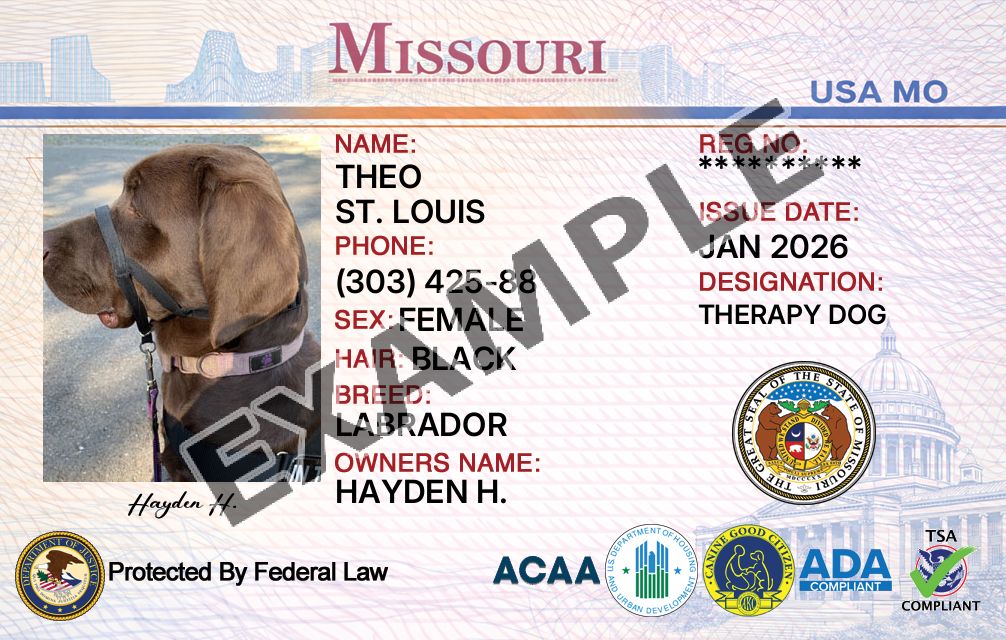
Service Dogs and Emotional Support Animals in Sullivan, Missouri
If you’re asking, “where do I register my dog in Sullivan County, Missouri for my service dog or emotional support dog?” the key thing to know is that local dog licensing (often tied to rabies vaccination and identification tags) is separate from service dog rights and emotional support animal (ESA) documentation. In Sullivan County, the most reliable starting point is the county’s public health agency, and city residents may also need to follow their municipality’s animal control or licensing process.
- There is no single universal federal “service dog registry” or federal “emotional support animal registry” used to establish legal status.
- Dog licensing requirements are set by local jurisdictions (county and/or city), and commonly require proof of current rabies vaccination.
- A dog can be a service dog (under disability law) and still be subject to local licensing just like any other dog.
Where to Register or License Your Dog in Sullivan County, Missouri
The offices below are official public agencies serving Sullivan County, Missouri residents for animal-health/public health reporting and (where applicable) municipal animal control. Licensing can be handled differently depending on whether you live inside a city limit versus in unincorporated county areas. If you are unsure which office applies to your address, start with the Sullivan County Health Department and ask where dog licensing and/or rabies tag requirements are administered for your location.
Sullivan County Health Department
PO Box 129
Milan, MO 63556
City of Sullivan (Missouri) — Animal Control
Sullivan, MO 63080
Overview of Dog Licensing in Sullivan County, Missouri
How dog licensing usually works locally
A dog license in Sullivan County, Missouri (or within a Sullivan County municipality) is typically a local registration that helps animal control and public agencies:
- confirm a dog has required vaccinations (especially rabies)
- identify an owned dog if it becomes lost
- support enforcement of local animal ordinances (leash, nuisance, bite reporting, etc.)
In many places, “licensing” is closely tied to a tag that goes on the dog’s collar/harness. Requirements and fees can vary depending on whether you live in a city (like Sullivan) or in unincorporated county areas.
Service dogs and ESAs: how they fit into local licensing
Even when a dog is a service dog or an emotional support dog, local jurisdictions may still require that the dog be licensed (or at minimum be current on rabies vaccination and identifiable). The “license” is about local animal regulation—not about proving disability-related status.
What You Need Before Registering a Dog
Common dog licensing requirements in Sullivan County, Missouri
Exact dog licensing requirements in Sullivan County, Missouri can vary by location inside the county, but most offices will ask for some combination of the items below:
- Proof of current rabies vaccination (rabies certificate showing vaccine date and expiration)
- Owner identification (photo ID is commonly requested)
- Proof of residency (especially if the license is issued by a city or is resident-only)
- Dog details (name, description, age, sex, color/markings; sometimes breed)
- Spay/neuter documentation if a fee schedule differs based on altered status
- Payment for any applicable licensing fee
If your dog is a service dog or emotional support dog
For local licensing, you generally provide the same core items (especially rabies proof). If you’re requesting a fee waiver or a specific tag type (if offered), ask the office what documentation they require. Keep in mind: service dog status is based on training and function, while ESA status is based on a disability-related need for emotional support (commonly documented by a qualified healthcare professional for certain housing situations).
Steps to Register or License a Dog in Sullivan County, Missouri
1) Confirm which jurisdiction issues the license for your address
- If you live inside the City of Sullivan, start with City of Sullivan Animal Control.
- If you live elsewhere in Sullivan County (or you’re not sure), start with the Sullivan County Health Department and ask which office issues dog licenses or tags for your physical address.
2) Make sure rabies vaccination is current
Rabies vaccination is a common baseline requirement. Keep a copy (paper or digital) of the rabies certificate. If a tag or certificate is lost, ask your veterinarian for replacement documentation.
3) Prepare your documents and dog details
Before calling or visiting, assemble:
- rabies certificate
- your ID
- proof of residency (if applicable)
- spay/neuter proof (if applicable)
- dog’s description for the license record
4) Ask how tags/renewals work (annual vs. multi-year)
Some places issue annual licenses; others align licensing with rabies vaccine expiration. Ask about renewal timing, replacement tags, and whether the dog must wear the tag on a collar/harness in public.
Service Dog Laws in Sullivan County, Missouri
No single federal service dog registration
In the U.S., service dog legal status is not created by registering with a universal federal registry. Instead, a service dog is generally defined by its function: a dog that is individually trained to do work or perform tasks for a person with a disability. Local licensing (like a county/city dog license) is separate and may still apply.
How service dogs relate to local dog licensing
- Local dog license requirements may apply to service dogs the same way they apply to other dogs.
- Service dogs should still be vaccinated and meet local public health and safety requirements.
- Some jurisdictions may offer fee adjustments for service animals; this varies by locality and should be confirmed with the licensing office.
Quick comparison: dog license vs. service dog vs. emotional support animal
| Category | Dog License (Local) | Service Dog | Emotional Support Animal (ESA) |
|---|---|---|---|
| What it is | Local registration/permit (often a tag) for dogs in a specific city/county jurisdiction. | A dog individually trained to perform tasks/work for a person with a disability. | An animal that provides emotional support related to a disability (commonly relevant for certain housing situations). |
| Who issues it | Local government office (city animal control, county office, or related agency depending on where you live in Sullivan County, Missouri). | No universal issuing agency; status is based on training and disability-related need. | No universal issuing agency; typically supported by documentation from a qualified healthcare professional for specific legal contexts (often housing). |
| Common proof needed | Rabies vaccination proof; owner/dog information; sometimes residency and spay/neuter proof. | Not a license/registration; practical proof is the dog’s trained behavior and task performance. | For housing-related requests, documentation from a qualified healthcare professional may be requested by a housing provider (when permitted by law). |
| Public access | Not a public-access right; it’s a local compliance requirement. | Generally has public-access rights in many settings where pets are not allowed (subject to applicable rules and the dog being under control). | Does not generally provide public-access rights in pet-restricted businesses. |
| Does local licensing still apply? | Yes—this is the licensing itself. | Often yes. Many places still require a dog license and rabies compliance for service dogs. | Often yes. ESAs are typically treated as pets for licensing/animal control purposes. |
Emotional Support Animal Rules in Sullivan County, Missouri
No universal ESA registration
Like service dogs, emotional support animals are not “registered” through one universal federal government registry. An ESA is generally a concept used in specific legal settings (most commonly housing). Whether an ESA is permitted somewhere is determined by the rules that apply to that setting, along with any documentation that may be legally requested.
How ESA status relates to a dog license in Sullivan County, Missouri
A common point of confusion is assuming ESA paperwork replaces local licensing. In most cases:
- An ESA is still a dog for purposes of local animal regulations like rabies vaccination and licensing.
- If your area requires a dog license in Sullivan County, Missouri (city or county), you generally still need to follow those rules.
- Licensing offices typically focus on public health and identification (rabies proof, tag, owner contact information), not ESA documentation.
Frequently Asked Questions
Where to register a dog in Sullivan County, Missouri if I’m not in the City of Sullivan?
Start with the Sullivan County Health Department (Milan) and ask which office issues dog licenses or tags for your exact physical address. Licensing authority can differ between incorporated municipalities and unincorporated areas of the county.
Do I need a dog license for a service dog in Sullivan County, Missouri?
Often, yes. Service dog status and local licensing are separate. Many jurisdictions require all dogs (including service dogs) to meet local vaccination rules and licensing/tag requirements. If any fee waiver is available, ask the licensing office what documentation they need.
Do emotional support dogs get a special county registration?
ESAs are not created through a universal registry. For local animal control and public health purposes, an emotional support dog is usually treated like any other dog regarding rabies vaccination and any applicable local licensing.
What is “animal control dog license Sullivan County, Missouri” referring to?
People often use that phrase when they’re trying to find the local office that enforces animal rules and issues tags. In Sullivan County, Missouri, that can mean municipal animal control (for city residents) and/or a county-level office that can direct you to the correct licensing process for your jurisdiction.
What if I can’t find licensing details for my small town or rural address?
Not every jurisdiction publishes licensing steps in the same way. If details aren’t clearly posted for your location, call the Sullivan County Health Department during normal business hours and ask specifically: (1) whether your address falls under a city ordinance for licensing, and (2) which office issues the license/tag and accepts proof of rabies vaccination.
What You May Need
Local tip for faster answers
When you call, say whether you live inside city limits (and which city), whether you need a “dog license” or “rabies/license tag,” and whether your dog is a pet, service dog, or emotional support dog. This helps staff direct you to the correct jurisdiction process quickly.
Register A Dog In Other Missouri Counties
Select your county below to get started with your dog’s ID card. Requirements and license designs may vary by county, so choose your location to see the correct options and complete your pup’s registration.
- Adair County Dog Registration
- Andrew County Dog Registration
- Atchison County Dog Registration
- Audrain County Dog Registration
- Barry County Dog Registration
- Barton County Dog Registration
- Bates County Dog Registration
- Benton County Dog Registration
- Bollinger County Dog Registration
- Boone County Dog Registration
- Buchanan County Dog Registration
- Butler County Dog Registration
- Caldwell County Dog Registration
- Callaway County Dog Registration
- Camden County Dog Registration
- Cape Girardeau County Dog Registration
- Carroll County Dog Registration
- Carter County Dog Registration
- Cass County Dog Registration
- Cedar County Dog Registration
- Chariton County Dog Registration
- Christian County Dog Registration
- Clark County Dog Registration
- Clay County Dog Registration
- Clinton County Dog Registration
- Cole County Dog Registration
- Cooper County Dog Registration
- Crawford County Dog Registration
- Dade County Dog Registration
- Dallas County Dog Registration
- Daviess County Dog Registration
- DeKalb County Dog Registration
- Dent County Dog Registration
- Douglas County Dog Registration
- Dunklin County Dog Registration
- Franklin County Dog Registration
- Gasconade County Dog Registration
- Gentry County Dog Registration
- Greene County Dog Registration
- Grundy County Dog Registration
- Harrison County Dog Registration
- Henry County Dog Registration
- Hickory County Dog Registration
- Holt County Dog Registration
- Howard County Dog Registration
- Howell County Dog Registration
- Iron County Dog Registration
- Jackson County Dog Registration
- Jasper County Dog Registration
- Jefferson County Dog Registration
- Johnson County Dog Registration
- Knox County Dog Registration
- Laclede County Dog Registration
- Lafayette County Dog Registration
- Lawrence County Dog Registration
- Lewis County Dog Registration
- Lincoln County Dog Registration
- Linn County Dog Registration
- Livingston County Dog Registration
- Macon County Dog Registration
- Madison County Dog Registration
- Maries County Dog Registration
- Marion County Dog Registration
- McDonald County Dog Registration
- Mercer County Dog Registration
- Miller County Dog Registration
- Mississippi County Dog Registration
- Moniteau County Dog Registration
- Monroe County Dog Registration
- Montgomery County Dog Registration
- Morgan County Dog Registration
- New Madrid County Dog Registration
- Newton County Dog Registration
- Nodaway County Dog Registration
- Oregon County Dog Registration
- Osage County Dog Registration
- Ozark County Dog Registration
- Pemiscot County Dog Registration
- Perry County Dog Registration
- Pettis County Dog Registration
- Phelps County Dog Registration
- Pike County Dog Registration
- Plater County Dog Registration
- Polk County Dog Registration
- Pulaski County Dog Registration
- Putnam County Dog Registration
- Ralls County Dog Registration
- Randolph County Dog Registration
- Ray County Dog Registration
- Reynolds County Dog Registration
- Ripley County Dog Registration
- Saline County Dog Registration
- Schuyler County Dog Registration
- Scotland County Dog Registration
- Scott County Dog Registration
- Shannon County Dog Registration
- Shelby County Dog Registration
- St. Charles County Dog Registration
- St. Clair County Dog Registration
- St. Francis County Dog Registration
- St. Louis County Dog Registration
- Ste. Genevieve County Dog Registration
- Stoddard County Dog Registration
- Stone County Dog Registration
- Taney County Dog Registration
- Texas County Dog Registration
- Vernon County Dog Registration
- Warren County Dog Registration
- Washington County Dog Registration
- Wayne County Dog Registration
- Webster County Dog Registration
- Worth County Dog Registration
- Wright County Dog Registration